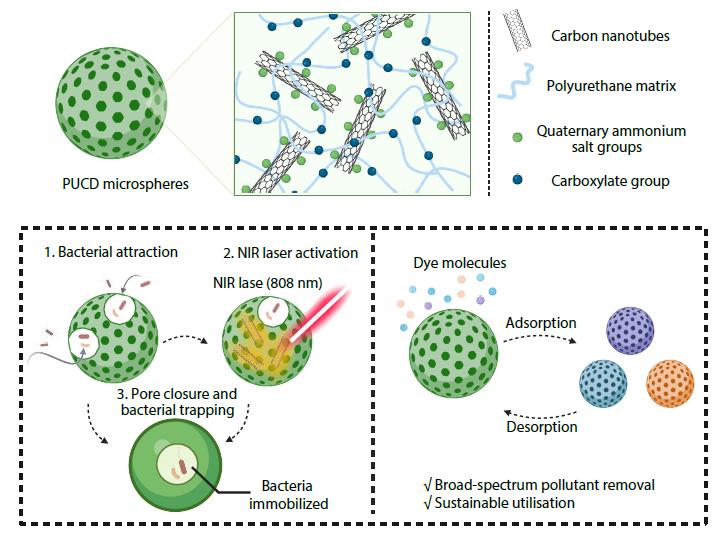
Hospital wastewater contains complex pollutants, including residual organic dyes and antibiotic-resistant pathogens, posing severe risks to ecosystems and human health. Conventional adsorbents, constrained by monopolar functional groups and limited surface sites, fail to remove both pollutants simultaneously. Here, we report an intelligent responsive polyurethane microsphere adsorbent doped with diallyl dimethylammonium chloride modified carbon nanotubes, termed as PUCD microspheres. The PUCD integrates bipolar adsorption sites, tunable micrometer-scale pores, and a near-infrared (NIR)-triggered in situ capture mechanism within a single platform, which achieves up to 98.3% dye removal, maintains strong adsorption performance across a wide pH range and retains 83.3% efficiency for rhodamine B after five cycles. Notably, the PUCD employs a temperature-responsive phase transition: under NIR irradiation, the microspheres undergo shrinkage, reducing the pore size to generate a ‘polymer trap’, enabling in situ capture of bacteria with >99% efficiencies for both Staphylococcus aureus and Escherichia coli. By immobilizing live bacteria, the PUCD microspheres substantially reduces the risk of pathogen desorption and toxin release. This promising platform offers a safe, efficient, and single-stage strategy for hospital wastewater purification, enabling the simultaneous elimination of dyes and pathogenic bacteria.
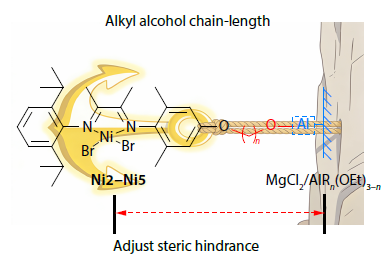
Heterogeneous polymerization represents a widely employed method in the polyolefin industry. In recent years, various heterogenization strategies for late transition metal catalysts have been developed, enabling effective control of polymer morphology and optimization of catalytic performance. However, while most studies have focused on designing anchoring groups and advancing support approaches, systematic investigations into how the support influences the catalytic behavior of the late transition metal catalysts. In this work, we fabricated supported α-diimine nickel catalysts by functionalizing the ligand with alkyl alcohol chains of varying lengths and supporting them onto MgCl2 supports. The ethylene polymerization behavior of these catalysts was then investigated. By precisely adjusting the alkyl alcohol chain length, the distance between the catalytically active metal center and the support surface was modulated. This approach demonstrates that support-induced steric hindrance effect can be effectively regulated by controlling the separation distance between the metal center and the support surface.
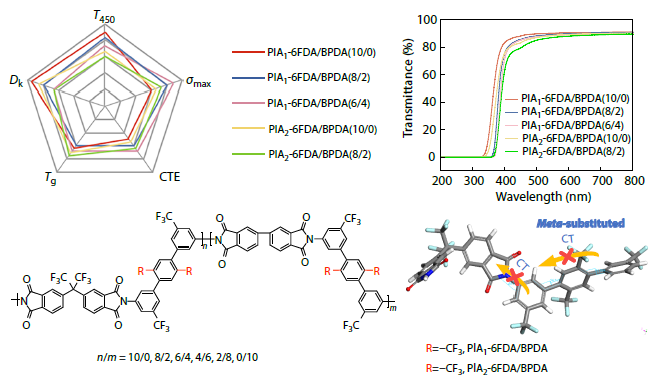
The development of high-performance transparent substrates is critical for next-generation flexible electronic devices. Herein, we designed two novel meta-substituted diamines incorporating trifluoromethyl (―CF3) and methyl (―CH3) groups to synthesize colorless copolyimide (CPI) films via copolymerization with 4,4′-(hexafluoroisopropylidene)diphthalic anhydride (6FDA)/3,3′,4,4′-biphenyltetracarboxylic dianhydride (BPDA). The combination of meta-substituted architecture and substituents enables the simultaneous attainment of an ultralow dielectric constant (Dk) and high transparency. The meta-substitution geometry and electronic effects of ―CF3/―CH3 effectively suppressed charge-transfer complex (CTC) formation, expanded fractional free volume (FFV), and restricted π-electron conjugation, as validated by DFT calculations and wide-angle X-ray diffraction (WAXD) analysis. The optimized CPI film (PIA1-6FDA/BPDA(10/0)) achieved outstanding transmittance (T450=88.15%), ultralow dielectric constant (Dk=2.08 at 1 kHz), and minimal dielectric loss (Df=0.0012), while maintaining robust thermal stability (Td5%>523 °C) and mechanical strength (σ = 87.5 MPa). This work establishes a molecular engineering strategy to concurrently enhance the optical and dielectric properties, positioning meta-substituted CPIs as promising candidates for transparent flexible devices.
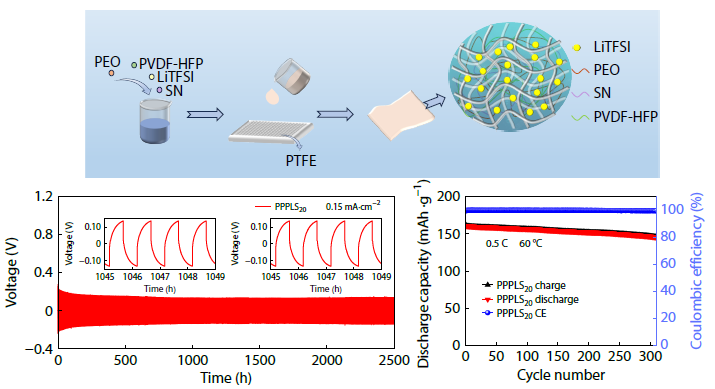
Solid polymer electrolytes (SPEs) are considered promising candidates for all-solid-state lithium metal batteries because of their easy preparation and good compatibility with lithium metal. However, their applications are restricted by their low ionic conductivity and poor mechanical properties. In this study, a composite solid polymer electrolyte composed of poly(ethylene oxide) (PEO), poly(vinylidene fluoride-co-hexafluoropropylene) (PVDF-HFP), plasticizer succinonitrile (SN), and polytetrafluoroethylene (PTFE) fibrous porous membranes was prepared. The PTFE fibrous membrane significantly enhanced the mechanical strength of the electrolyte as a supporting framework. SN reduced the crystalline regions of PEO and facilitated rapid lithium-ion transport. PVDF-HFP promoted lithium salt dissolution and improved the electrochemical stability of the electrolyte. Accordingly, the optimized PTFE/PEO/PVDF-HFP/SN polymer electrolyte exhibited a tensile strength of 3.31 MPa at 352% elongation and demonstrated an ionic conductivity of 7.6×10⁻⁴ S·cm–1 at 60 °C. Lithium symmetric cells maintained stable cycling for over 2500 h at 0.15 mA·cm–2, and Li//LiFePO4 full cells showed a high capacity retention of 91.6% after 300 cycles at 0.5 C, with coulombic efficiency consistently exceeding 99.9% throughout cycling.
Alexander M. Mitroshin, Serguei A. Miltsov, Ilya E. Kolesnikov, Dmitriy A. Lypenko, Artem V. Dmitriev, Larisa S. Litvinova, Vladislav M. Korshunov, Ilya V. Taydakov, Elena V. Ushakova, Anastasia V. Rogova, Felix N. Tomilin, Alexander V. Yakimansky
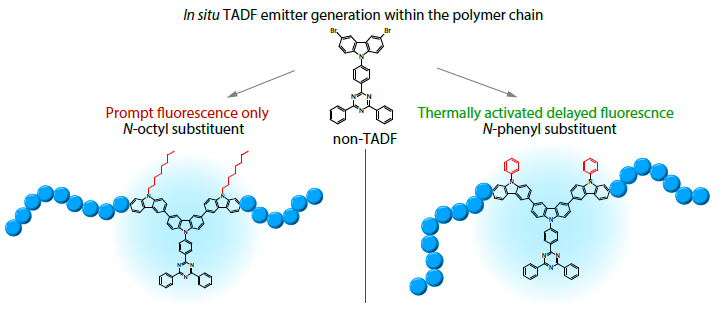
The development of polymeric materials that exhibit blue thermally activated delayed fluorescence (TADF) is of great interest for optoelectronic applications. However, achieving TADF in polymers often requires an elaborate monomer design. The high-energy local triplet state (3LE) of carbazole complicates its application despite the molecular orbital arrangement being suitable for blue emission. Here, we present an approach to polymer design that makes it possible to solve this problem. We demonstrate the in situ formation of a TADF donor-acceptor system during Suzuki polycondensation, creating an extended carbazole-based donor matrix coupled with a triazine acceptor. The resulting polymer exhibited efficient TADF with a low energy gap (ΔEST) value if a phenyl N-substituent, enabling essential electron delocalization, was present in the carbazole moiety. This work establishes a versatile platform for developing carbazole-based TADF polymers, overcoming the fundamental limitations that hinder their widespread application.
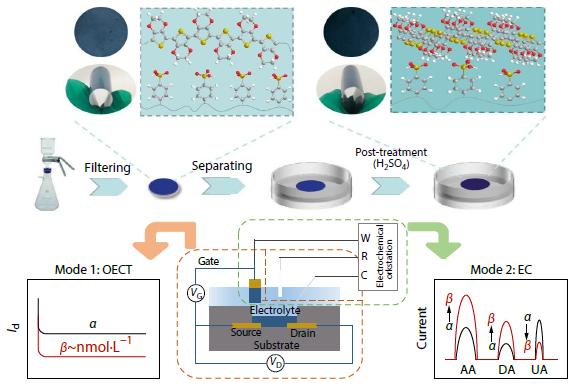
Glucose, ascorbic acid (AA), uric acid (UA), and dopamine (DA) are vital biomarkers whose dynamic concentrations correlate with critical diseases; however, multiplexed detection remains challenging for conventional electrochemical sensors because of their limited sensitivity and selectivity. Here, we present a millimeter-scale all-poly(3,4-ethylenedioxythiophene):poly(styrenesulfonate) (PEDOT:PSS) organic electrochemical transistor (OECT) platform that integrates dual-mode sensing with enzyme/metal-free operation for ultrasensitive biomarker monitoring. By engineering polycrystalline PEDOT:PSS channels via H2SO4 post-treatment, the device achieves record-high conductivity (about (2312.0±29.9) S·cm–1), maximum transconductance (about (2.82±0.12) mS), and on/off ratio (about 210.0±7.8), enabling signal amplification at low gate voltages. The dual-mode strategy combines the selectivity of electrochemistry with the sensitivity of OECTs, realizing simultaneous detection of glucose, AA, UA, and DA with clinical-level sensitivity: detection limits down to 8 nmol·L–1 (glucose), 0.5 nmol·L–1 (AA), 5 nmol·L–1 (DA), and 0.5 nmol·L–1 (UA). Validation using human urine samples yielded recovery rates of 94%–114%. This flexible sensing platform provides a new pathway for the development of wearable biosensors for precision diagnostics.
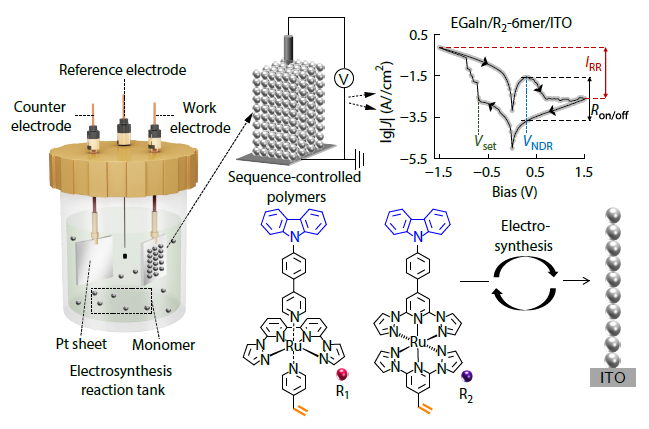
D-π hybridization is a key structural feature that may significantly affect the intrinsic electronic properties of metallopolymers. Herein, we present the electrosynthesis and memristive properties of metallopolymers using the distinct d-π hybridization monomers R1 and R2. R1 (RuII-(tpz)Cl2) features tetradentate ligands (tpz, 6,6'-di(1H-pyrazol-1-yl)-2,2'-bipyridine) enforcing quasi-octahedral geometry; R2 (RuII-(bpp)2) incorporates tridentate ligands (bpp, 2,6-di(1H-pyrazol-1-yl)pyridine) inducing pronounced geometric distortion. The planar ligand (tpz) in R1 facilitates ordered molecular assembly through high conformational rigidity and extensive π-π stacking, resulting in increased molecular densities and enhanced morphological uniformity compared to R2 metallopolymers. Due to pyrazole’s weaker π-acceptance and stronger σ-donation compared to pyridine, R1 exhibits a 119 nm red-shift in metal-to-ligand charge transfer (MLCT) band and a 30 mV anodic shift in Ru+2/+3 redox potential relative to R2. Coupled with a reduced HOMO–LUMO gap, the uniform and ordered structure leads to a lower conductance decay constant in R1. Additionally, R2 metallopolymers exhibit superior memristive performance (characterized by lower switching voltage and higher switching ratio) via redox-induced aromatic transitions in axial ligands enhancing electronic delocalization. This work compares two metallopolymers with different ligand geometries, revealing how this difference leads to distinct charge transport and memristive behaviors.
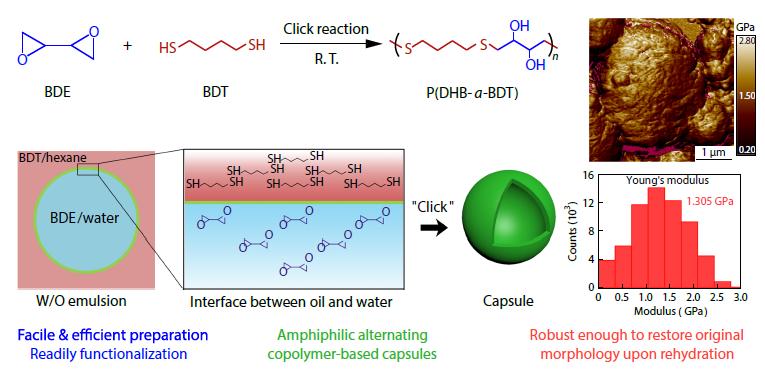
The preparation and functionalization of polymeric capsules attract intense attention due to their application in various areas. Herein we presented an amphiphilic alternating copolymer (ACP)-based microcapsule which is both robust and readily-functionalized through interfacial click polymerization. A water-in-oil emulsion was constructed to act as the reaction medium, the hydrophilic 1,3-butadiene diepoxide (BDE) in water phase reacted with the oleophilic 1,4-dibutanedithiol (BDT) in oil phase at the water-oil interface to form the amphiphilic ACP named poly(2,3-dihydroxy butylene-alt-butylene dithioether) (abbreviated as P(DHB-a-BDT) below), which would deposite in situ to form the micro-sized capsules. Significantly, the dried capsules are robust enough to be rehydrated once the water was added and almost restored their original morphologies. Further elucidation showed that the Young’s modulus of these capsules exceeded 1 GPa. As long as we know, it is the first time for the mechanical properties of the ACP-based microstructures being investigated. Besides, functionalization could be achieved simultaneously with the formation process. As a proof of concept, positive-charged capsules were successfully obtained through click copolymerization. Stemming from the unique characteristics of amphiphilic ACPs which combined both merits of click chemistry and interfacial reactions, all these features of the current method as well as the resultant capsules may promote the application of the polymeric capsules.
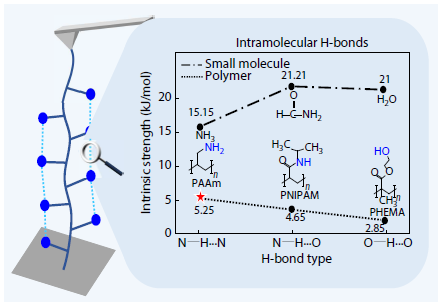
Quantifying the hydrogen bond (H-bond) strength of polymers is essential for rational design of advanced materials. However, direct measurement remains challenging because of the structural complexity of polymers and the weak nature of H-bonds. Vacuum-based single-molecule force spectroscopy (Vac-SMFS) offers a new and precise approach for such measurements. Using polyallylamine (PAAm) as a model polymer, the intrinsic strength (i.e., strength without external influences) of representative N―H···N H-bonds was quantified to be about 5.25 kJ·mol–1. Comparative Vac-SMFS analysis across different polymer systems revealed that the N―H···N H-bonds in PAAm are unexpectedly stronger than the N―H···O H-bonds in poly(N-isopropylacrylamide) (PNIPAM) and the O―H···O H-bonds in poly(hydroxyethyl methacrylate) (PHEMA). This trend contrasts with that of established small-molecule systems. These results highlight how side-chain length and spatial configuration dictate polymer H-bond strengths, expanding the fundamental knowledge of polymer interactions and enabling the rational design of next-generation functional materials.
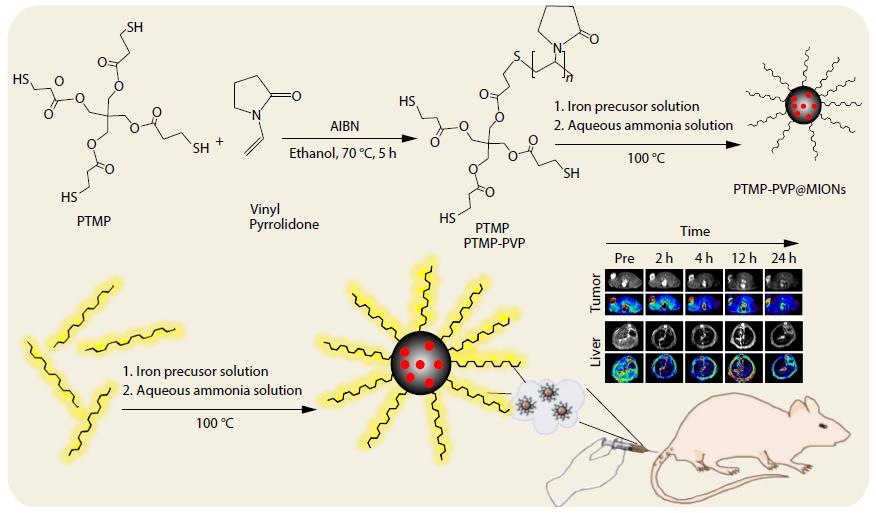
Magnetic resonance imaging (MRI) is one of the most widely used diagnostic techniques. Iron oxide nanoparticles, as a promising kind of contrast agents, have attracted intense research interest due to their low toxicity and superparamagnetism. However, it is still a great challenge to prepare ideal iron oxide based contrast agents with high uniformity, excellent water solubility and biocompatibility. In this paper, a novel water-soluble polymer ligand pentaerythritol tetrakis 3-mercaptopropionate-poly(N-vinyl-2-pyrrolidone) (PTMP-PVP) was used as a capping reagent to prepare iron oxide nanoparticles MIONs@PTMP-PVP through one-step co-precipitation of iron precursors in aqueous solution at 100 °C. The obtained nanoparticles MIONs@PTMP-PVP had a small size and narrow size distribution, and they were found to be biocompatible as determined through CCK-8 assay and histology analysis. In vivo MRI study demonstrated that the obtained MIONs@PTMP-PVP can be potentially used as an effective T2-weighted MRI contrast agent.
In contrast to cyclic polymers with ring-like backbones, side-chain cyclization is another intriguing structural feature that has not been extensively studied. In this study, a library of orthogonally protected monomers featuring monocyclic, dicyclic, or tricyclic pendant motifs was designed and prepared based on malic acid derivatives. Polyesters with precise chemical structures and uniform chain lengths were prepared modularly through iterative growth. Meticulous control over the chemical details allows for a close investigation of the topological effects on the polymer properties. Compared to their linear side chain counterparts, the presence of cyclic pendant groups has a significant impact on chain conformation, leading to a reduction in hydrodynamic volume and an enhancement in the glass transition temperature. These results underscore the potential of tailoring polymer properties through rational engineering of side chain topology.
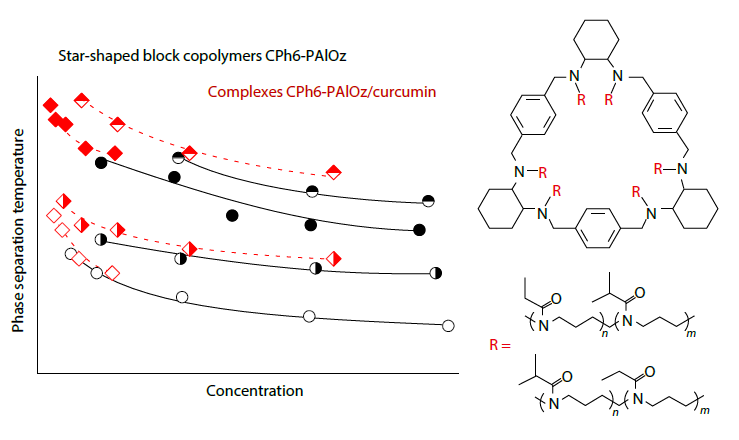
Star-shaped six-arm polymers with hexaaza[26]orthoparacyclophane core and arms of block copolymers of poly-2-ethyl-5,6-dihydrooxazine with poly-2-isopropyl-5,6-dihydrooxazine were synthesized successfully using cationic ring-opening polymerization. The ratio of blocks, the order of their attachment to the core, and arm length were varied. Conformation of synthesized stars was determined by methods of molecular hydrodynamics and optics. It has been shown that star-shaped molecules were characterized by high intramolecular density, and the arm folding increased with their lengthening. The influence of the structure of block copolymers and their molar mass on the critical micelle concentration has been established. Complexes of synthesized star-shaped block copolymers with curcumin were obtained and the efficient binding of curcumin to polymer molecules was demonstrated. The behavior of the aqueous solutions of the prepared polymer stars and their complexes with curcumin was investigated by light scattering and turbidimetry methods. The influence of the structure and molar mass of star polymers on their thermoresponsiveness and the phase separation temperatures in aqueous solutions was analyzed. A slight increase in the phase separation temperature was found on passage from polymer solutions to solutions of polymer complexes with hydrophobic curcumin.
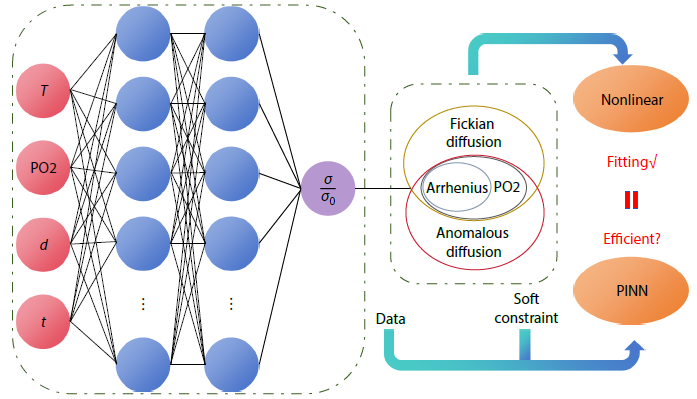
Accelerated aging tests are widely used to rapidly evaluate the durability of materials, of which thermal-oxidative aging is the most common approach. To quantitatively predict the effects of multiple coupled factors, this study takes polyamide66 reinforced with glass fiber (PA66-GF) as a model system and proposed a high-precision paradigm for coupled thermal-oxidative aging. By integrating Arrhenius-type reaction kinetics with oxygen diffusion, a predictive formula that holistically captures the nonlinear synergistic effects of multiple factors was developed, thereby overcoming the limitations of traditional single-variable models. A systematic evaluation of the stepwise improved formulas through nonlinear fitting showed that the coefficient of determination (R2) increased from 0.223 to 0.803, elucidating the fundamental reason why conventional approaches fail in quantitative prediction. These formulae were further embedded as physical constraints into a physics-informed neural network (PINN), which further enhanced the predictive performance, with the proposed formula achieving a peak R2 of 0.946. The results highlight that robust data fitting alone is insufficient; the decisive factor for the success of PINN lies in whether the embedded formula faithfully reflects the underlying physical mechanisms. When applied to polyamide 6 reinforced with glass fiber (PA6-GF), the Formula-constrained PINN maintained a high level of accuracy (R2=0.916), demonstrating its strong cross-system generalizability. In summary, this work establishes a robust hybrid physics-machine learning framework that combines high accuracy with transferability for predicting the thermal-oxidative aging behavior of composite material systems.
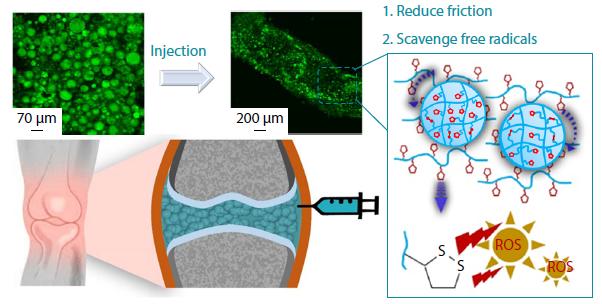
Early knee osteoarthritis (KOA) is characterized by progressive degeneration of the articular cartilage, synovial inflammation, and excessive accumulation of reactive oxygen species (ROS). At present, intra-articular injection of hyaluronic acid (HA) is widely used to alleviate symptoms; however, its lubrication persistence, antioxidant, and anti-inflammatory abilities are limited, and it is difficult to effectively delay the early process of cartilage degeneration. Based on this, hyaluronic acid-g-lipoic acid (HA-LA) was synthesized by esterification reaction, and HA-LA microspheres were prepared by a reversed-phase emulsion method, which was combined with a macromolecular HA-LA solution to form injectable hydrogels. The objective of this study was to evaluate the efficacy of an injectable hydrogel based on hyaluronic acid-g-lipoic acid microspheres (HA-LA MS) for the treatment of KOA and to verify its injectability, lubricity, reactive oxygen species (ROS) scavenging ability, and anti-inflammatory effects. The results show that the HA-LA MS hydrogel has excellent shear thinning characteristics and continuous injectability, and its microsphere structure significantly reduces the interfacial friction coefficient through the rolling effect. In vitro experiments have shown that the hydrogel can efficiently scavenge ROS, reduce the expression of inflammatory factors, and is non-cytotoxic. The HA-LA MS injectable hydrogel has excellent lubricity, ROS scavenging ability, and anti-inflammatory effects in vivo, which can effectively delay the degeneration of early KOA cartilage, and its efficacy is significantly better than that of traditional hyaluronic acid, making it a promising intra-articular injection preparation.
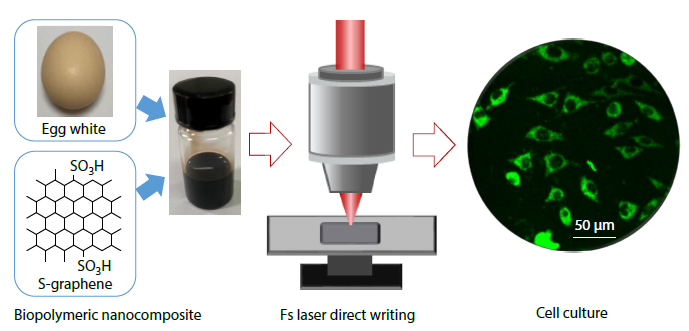
Biopolymeric nanocomposites have attracted considerable attention because of their biocompatibility, biodegradability, and unique physicochemical properties. It is essential to manufacture three-dimensional (3D) biocompatible micro/nanostructures using biopolymeric nanocomposites. Herein, we demonstrate the high-fidelity fabrication of biocompatible 3D features with sub-50 nm resolution using femtosecond laser direct writing (FsLDW) of a biopolymeric nanocomposite composed of egg white and sulfonated graphene (S-graphene). The biopolymer nanocomposite acts as a negative photoresist suitable for water-based lithography. The introduction of S-graphene not only dramatically lowered the laser power threshold but also significantly modulated the morphology of the 3D features constructed by FsLDW. Microstructures with porous, rough, or smooth morphologies were obtained by optimizing the S-graphene concentration and laser scanning speed. The fabricated egg-white/S-graphene microstructures exhibited biocompatibility and environmental degradability. Egg white/S-graphene was also employed to fabricate diffractive gratings with superior optical quality. This study provides a promising method to manufacture biocompatible 3D features with controllable morphology, which has potential applications in biological and photonic fields.
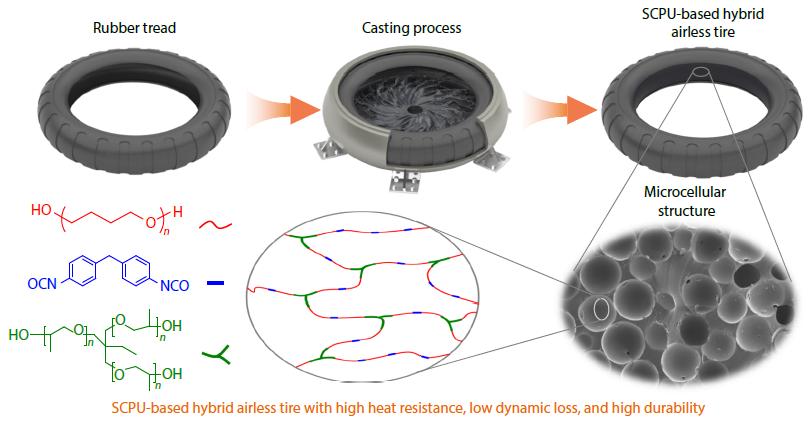
Airless tires are essential for enhancing the safety, reliability, and convenience of maintenance of electric bicycles. Polyurethane (PU) is considered a promising candidate for such applications owing to its versatile properties. However, their use is limited by insufficient heat resistance and excessive dynamic heat generation under cyclic loading. In this study, star-shaped trifunctional polypropylene glycerol (PPG3) was incorporated into conventional poly(tetramethylene glycol) (PTMG) and 4,4'-methylenediphenyl diisocyanate (MDI)-based systems to construct microporous star-shaped casting polyurethanes (SCPU), with water serving as a green foaming agent. Unlike conventional small-molecule trifunctional crosslinkers that create junctions within hard segment domains, PPG3 introduces long flexible arms between the hard segments, anchoring the crosslinking points at its molecular core. The large steric hindrance of PPG3 effectively suppresses soft segment crystallization and lowers the degree of microphase separation, whereas the crosslinked network restricts chain mobility, thereby reducing dynamic heat generation. These structural features also enhance the heat resistance, yielding a softening temperature of 183 °C, which is 30.9% higher than that of polyurethane without PPG3. When applied to airless tires by casting SCPU into rubber treads, the fabricated hybrid airless tires achieved a rolling distance of over 3000 km under a load of 65 kg at 25 km/h without structural failure, satisfying practical performance requirements. This strategy offers a simple, solvent-free, and environmentally friendly process, underscoring the potential of SCPU for scalable production of high-performance airless tires.
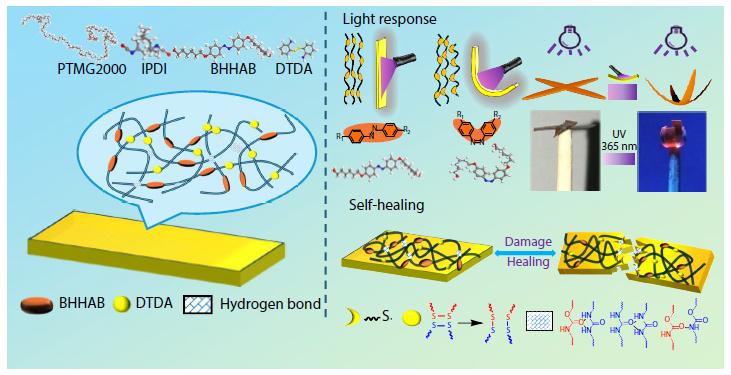
Azobenzene-based polymer actuators show great promise for photoactuation owing to their unique photoisomerization behavior and tailorable molecular programmability. However, conventional systems are limited by inadequate mechanical robustness, self-healing, and recyclability, hindering their practical implementation. Herein, we present a high-performance azobenzene-functionalized polyurethane (AzoPU) elastomer actuator designed via molecular engineering of photoactive azobenzene moieties and dynamic disulfide bonds. AzoPU exhibits exceptional mechanical properties with retained performance after multiple reshaping cycles, enabled by well-engineered hard-soft segments and synergistic stress dissipation from weak covalent bonds/hierarchical hydrogen bonds. It achieves over 93% self-healing efficiency at room temperature owing to the synergistic interplay of disulfide bonds in the polymer backbone and intermolecular hydrogen bonds. Furthermore, it demonstrates remarkable light-triggered actuation behavior, achieving a phototropic bending angle exceeding 180° toward the light source within 45 s. To showcase its practical potential, proof-of-concept photoactuated devices with flower-, hook-, and gripper-like and local-orientation processed strip-shaped structures were fabricated, which exhibited rapid and reversible light-triggered deformation. This study proposes a novel strategy for the development of intelligent polymeric materials that integrate light responsiveness, self-healing, and recyclability, thus holding great promise for applications in flexible electronics, smart actuators, and sustainable functional materials.
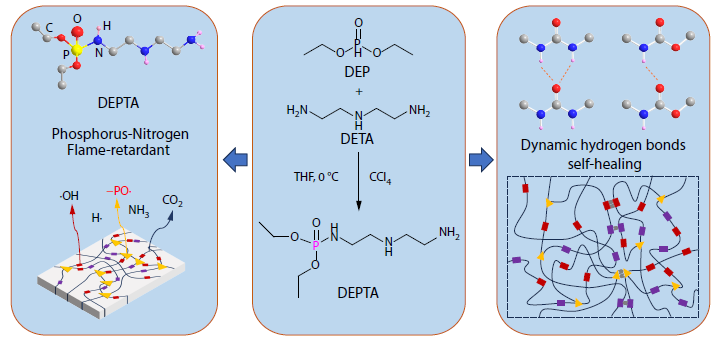
Although poly(urethane-urea) elastomers (PUEs) possess excellent mechanical properties and durability, their inherent flammability and inability to self-repair after damage significantly limits their applications in high-end fields. To address this challenge, this study employs a supramolecular chemistry approach by simultaneously incorporating multiple hydrogen bonds as dynamic cross-linking points and a phosphorus-nitrogen synergistic flame-retardant structure into the poly(urethane-urea) network. The multiple hydrogen bonds endow the material with efficient intrinsic self-healing capability, while the phosphorus-nitrogen flame retardant ensures outstanding thermal stability and flame resistance, leading to the successful synthesis of a high-performance multifunctional poly(urethane-urea) elastomer. Experimental results demonstrated that when the content of the flame retardant diethyl (2-((2-aminoethyl)amino)ethyl)phosphoramidate (DEPTA) was 10 wt%, the resulting PUE/10%DEPTA achieved a V-0 rating in the vertical burning test, with a limiting oxygen index (LOI) of 30%. Concurrently, the elastomer maintained good toughness, exhibiting a tensile strength of 27.3 MPa, an elongation at break of 601%, and a self-healing efficiency of up to 94.46%. This breakthrough shows significant promise for advanced engineering applications that demand fire safety, structural durability, and extended service life through self-repair.
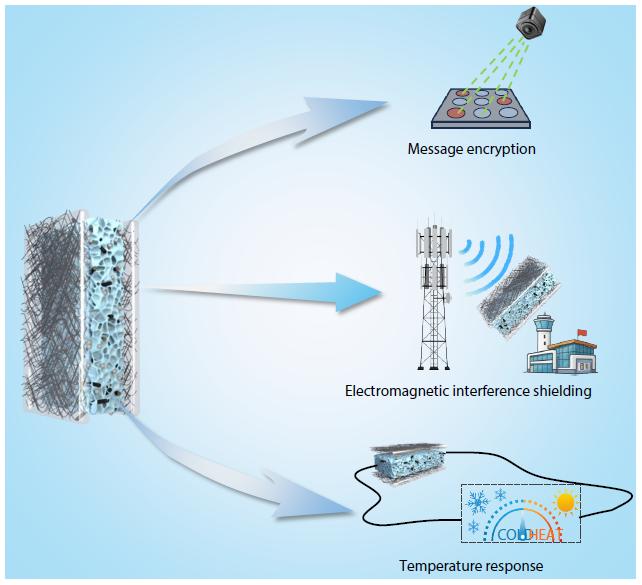
With the rapid development of intelligent electronic and military equipment, multifunctional flexible materials that integrat electromagnetic interference (EMI) shielding, temperature sensing, and information encryption are urgently required. This study presents a bio-inspired hierarchical composite foam fabricated using supercritical nitrogen foaming technology. This material exhibits a honeycomb structure, with pore cell sizes controllable within a range of 30–92 µm by regulating the filler. The carbon fiber felt (CFf) provides efficient reflection of electromagnetic waves, while the chloroprene rubber/carbon fiber /carbon black foam facilitates both wave absorption and temperature monitoring through its optimized conductive network. This synergistic mechanism results in an EMI shielding effectiveness (SE) of 60.06 dB with excellent temperature sensing performance (The temperature coefficient of resistance (TCR) is −2.642%/°C) in the 24–70 °C range. Notably, the material has a thermal conductivity of up to 0.159 W/(m·K), and the bio-inspired layered design enables information encryption, demonstrating the material's potential for secure communication applications. The foam also has tensile properties of up to 5.13 MPa and a tear strength of 33.02 N/mm. This biomimetic design overcomes the traditional limitations of flexible materials and provides a transformative solution for next-generation applications such as flexible electronics, aerospace systems and military equipment, which urgently need integrated electromagnetic protection, thermal management and information security.
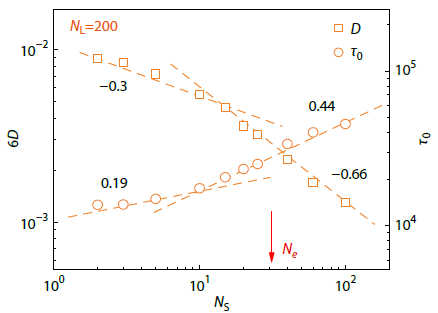
The equilibrium dynamics and nonlinear rheology of unentangled polymer blends remain inadequately understood, especially regarding the influence of short-chain matrix length NS on the structure and rheological behavior of dispersed long chains. Using molecular dynamics simulations based on the Kremer-Grest model, we systematically explore the NS-dependence of static conformations, equilibrium dynamics, and nonlinear shear responses in unentangled long-chain/short-chain polymer blends. Our results demonstrate a decoupling between the static and dynamic sensitivity to NS: while the static chain size, Rg, follows Flory theory with slight swelling at small NS due to incomplete excluded volume screening, the diffusion coefficient, D, and the relaxation time, τ0, exhibit a strong, non-monotonic NS-dependence, transitioning from monomeric friction dominance at small NS to collective segmental rearrangement at large NS. Additionally, we observe partial decoupling between the viscous and normal stress responses: while the zero-shear viscosity, η, is strongly NS-dependent, the first and second normal stress coefficients, Ψ1 and Ψ2, collapse onto universal curves when scaled by the dimensionless shear rate, $ \dot{\gamma } $τ0, suggesting a common mechanism of orientation and stretching. Under shear, long chains compress in the vorticity direction λz ~ Wi−0.2, which reduces collision frequency and contributes to shear thinning, while the scaling of weaker orientation resistance mG ~ Wi0.35 reflects hydrodynamic screening by the short-chain matrix. These findings highlight the limitations of single-chain models and emphasize the necessity of considering NS-dependent matrix dynamics and flow-induced structural changes in understanding the rheology of unentangled polymer blends.
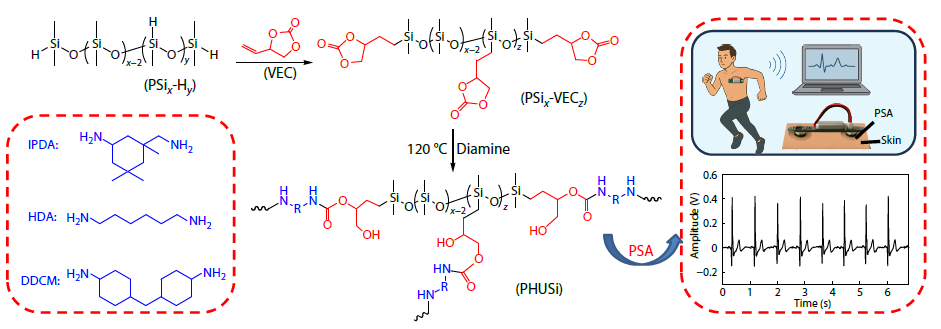
Silicone-based pressure-sensitive adhesives (Si-PSAs) are valued for their thermal stability, flexibility, and biocompatibility, but their weak bonding strength restricts high-performance use. Polyurethane-modified Si-PSAs enhance adhesion, however diisocyanates remain essential. The raw materials of isocyanates are toxic, and their synthesis involves phosgene. To make up for those shortcomings, a series of poly(hydroxy urethane-siloxane) PSAs, named as PHUSi here, were synthesized through the ring-opening reaction of cyclic carbonate-functionalized polysiloxanes (PSix-VECz) with various aliphatic diamines. The PSix-VECz precursors were prepared via the hydrosilylation of hydrogen-containing polysiloxanes (PSix-Hy) with 4-vinyl-1,3-dioxolan-2-one (VEC). The chemical structures of PSix-Hy, PSix-VECz and PHUSi were characterized, and bonding properties of PHUSi were systematically evaluated. The influence of architectures on adhesive performance was elucidated through comprehensive analyses, including rheology, crosslink density assessment, and so on. These studies revealed that the tailored design of PHUSi adhesives combine the advantages of traditional Si-PSAs with enhanced adhesion while eliminating isocyanate toxicity. The optimized PHUSi formulation achieved remarkable 180° peel strength (76.5 N/m on skin) and maximum probe tack force (1.61 N), enabling secure 24 h attachment of flexible sensors to skin. These properties make PHUSi particularly suitable for medical applications, as demonstrated by successful implementation in flexible electrocardiogram devices, offering a biocompatible, high-performance adhesive.
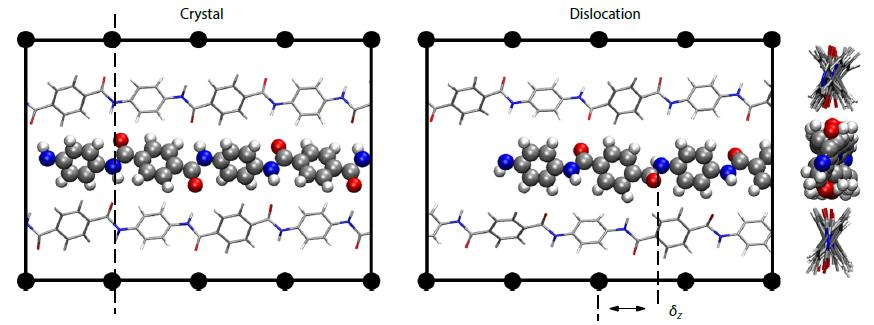
This study uses all-atom molecular dynamics simulations to investigate the dislocation propagation, stress transmission, and mechanical properties in poly(p-phenylene terephthalamide) fibers under uniaxial tension. The results indicate that the dislocation propagates and the stress transfers not only along the fiber axis but also between adjacent molecular chains through hydrogen bonds, demonstrating their influence on the yield behavior. As the degree of polymerization increases, breakage of covalent bonds and interchain slippage contribute to the yield of fibers together. This work provides theoretical guidance for the design and manufacturing of high-performance fibers.
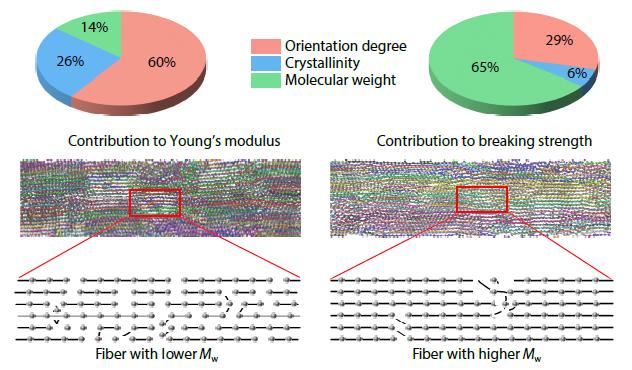
UHMWPE fibers exhibit impressive modulus and strength, but they have not reached their theoretical limits. Researchers focus on molecular weight, orientation, and crystallinity of UHMWPE, yet their contributions to mechanical properties are unclear. Molecular dynamics simulations are valuable but often limited by computational constraints. Our aim is to simulate higher molecular weights to better represent real UHMWPE fibers. We used Packmol and Polyply methodologies to construct PE systems, with Polyply reproducing more reasonable properties of UHMWPE fibers. Additionally, tensile simulations showed that orientation and crystallinity greatly impact Young's modulus more than molecular weight. Energy decomposition indicated that higher molecular weights lead to covalent bonds that can withstand more energy during stretching, thus increasing breaking strength. Combining simulations with machine learning, we found that orientation has the most significant impact on Young’s modulus, contributing 60%, and molecular weight plays the most crucial role in determining the breaking strength, accounting for 65%. This study provides a theoretical basis and guidelines for enhancing UHMWPE's modulus and strength.
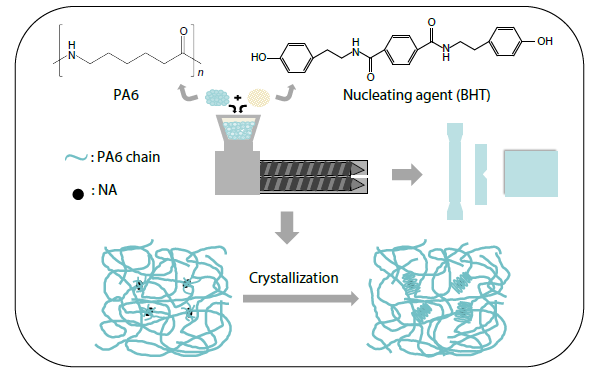
The chemical structure of polyamide 6 (PA6) dictates that only 50% of hydrogen bonds participate in crystallization during the crystallization process, resulting in the properties of its products being significantly dependent on the molding process. Therefore, the design and development of nucleating agents suitable for PA6 holds great practical significance for high-performance PA6 materials. Amide-based nucleating agents can effectively improve the crystallization rate by increasing intermolecular hydrogen bond density. Further introduction of hydroxyl groups can enhance the hydrogen bonding interactions between the nucleating agent and PA6. In this study, a hydroxyl-containing amide-based nucleating agent, BHT, was designed and synthesized using a tyramine-based biomass as the raw material. These results demonstrated that BHT exhibited good structural compatibility with PA6. After adding 1 wt% BHT, the crystallization temperature of PA6 increased from 170.9 °C to 193.3 °C, the crystallinity increased 16.6%, the heat distortion temperature and Vicat softening temperature rose to 89.5 and 187.8 °C, respectively, the haze decreased to 46%, achieving the synergistic optimization of mechanical, thermal, and optical properties. The in situ time-resolved FTIR results indicated that the addition of BHT increased the enthalpy of hydrogen bond formation during the nucleation stage, facilitated the segmental conformation adjustment of PA6, and enhanced the molar concentration of trans-conformations, ultimately leading to an improvement in the crystallization rate.
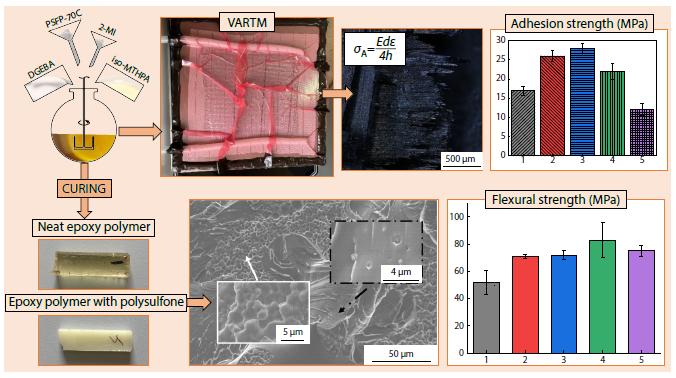
Carbon-fiber-reinforced plastics (CFRP) with improved mechanical properties based on modified epoxy binders were investigated in this study. By adding 15 parts by weight (p.b.w.) of copolymer of polysulfone with cardo phthalide group (PSFP-70C) to the epoxyanhydride binder, the flexural strength of the epoxy polymer was increased by 60%, the CFRP based on it by 57%, the flexural modulus of the epoxy polymer was increased by 83%, and the composite by 96%. The adhesion strength of the binder to carbon fiber reached a high level at 10 p.b.w. of thermoplastic modifier and increased by 65% compared to the unmodified binder. Scanning electron microscopy (SEM) was used to determine that in epoxyanhydride systems with a polysulfone content of 5–15 p.b.w., the structure belongs to the "matrix dispersion" type and with a content of 20 p.b.w. to the "interpenetrating phase" type. A heterogeneous structure was also observed using dynamic mechanical analysis.
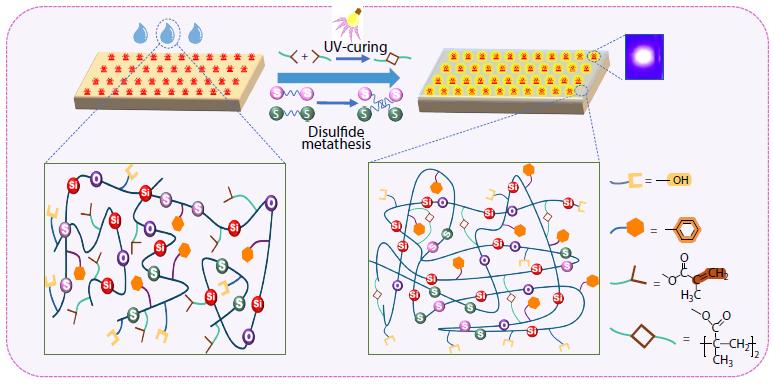
Mini light-emitting diodes (Mini-LEDs) show great application potential in high-end displays owing to their superior pixel density, brightness, responsiveness, and efficiency. However, current packaging materials for Mini-LEDs are predominantly thermally cured, which is energy- and time-consuming and can adversely affect electronic components. In this study, a novel UV-curable silicone resin containing phenyl, disulfide, and acryloyl groups (SPASR) is developed from commercially available siloxanes. The resin exhibits a refractive index (nd) higher than 1.5, and it can be cured within 30 s under UV irradiation. After curing, it exhibits an optical transparency exceeding 92%, a lap adhesion strength of up to 1.84 MPa, and good thermostability (T5%>265 °C). Notably, the volume shrinkage is less than 4.83%, attributed to the release of photopolymerization stress via UV-induced disulfide metathesis during UV curing. Mini-LEDs encapsulated with this resin show luminescence properties comparable to those of conventional thermally-cured sealants, and show excellent sealability wihtout visible penetration after being immersed in red ink for 12 h. Consequently, these excellent properties make the SPASR resin an ideal candidate for microelectronic encapsulation, offering a more reliable and efficient solution for the electronics industry.