Conformational entropy, one of the central concepts of polymer physics, is the key to revealing physical characteristics of polymers. Despite an increased repertoire of conformational-entropy effects in the structural formation, transition, and properties of polymer systems, the physical origin of conformational entropy remains less understood compared to interaction energy and other types of entropy. This review seeks to provide a conceptual framework unveiling several principles and rules of conformational entropy in governing the structures and properties of polymers, from the perspective of fundamental physics and statistical mechanics. First, we focus on the fundamentals of entropy in thermodynamics, leading to the theoretical basis for the elucidation of conformational entropy. Second, we delineate the physical nature of statistics and dissipation of conformational entropy and its essential dependence on the environmental heat bath. Next, we explore the principles of conformational entropy in driving the ordering transitions of various systems of polymers and their nanocomposites, elucidating the emergent and collective behaviors as well as the interplay between energetic interactions and entropy. Moreover, we demonstrate how the concept of conformational entropy is generalized to the biological systems and other soft matters. Finally, we discuss future directions to signify this framework originated from polymers.
The practical deployment of polyester-based solid electrolytes such as poly(ε-caprolactone) (PCL) is hindered by two inherent material-level constraints: the semicrystalline nature of PCL chains severely restricts segmental mobility and limits ionic conductivity, whereas interfacial instability against lithium metal anodes jeopardizes long-term cycling. Based on orthogonal polymerization technology combined with electrolyte structural design concepts, this work achieved a one-step fabrication of a polyester-based block copolymer electrolyte (BCPE) system comprising fluorinated segments (PTFEA) and poly(ε-caprolactone) (PCL). Structurally, this design enables a dual breakthrough in electrochemical performance: on one hand, the introduction of fluorinated segments with steric hindrance effects can effectively disrupt the regular arrangement of the PCL main chain, reduce the crystallinity of PCL within the polymer electrolyte, and significantly enhance the segmental mobility of the polymer matrix; on the other hand, during the charge/discharge cycles of lithium batteries, fluorinated segments can induce the formation of a LiF-rich solid electrolyte interphase (SEI) through in situ decomposition reactions, achieving interface stabilization and homogeneous lithium-ion deposition regulation.
The development of solar-driven interfacial evaporation technology is pivotal for addressing global water scarcity. However, it is hindered by the difficulty in synergizing high photothermal conversion with low water evaporation enthalpy into a single material. Herein, we propose an iron-aldehyde-cooperative dynamic covalent anchoring strategy, successfully constructing a covalently locked, hydroxymethyl-functionalized PEDOT-PVA integrated dual-network hydrogel (MEPH). This strategy employs Fe3+ to achieve the one-step in situ oxidative polymerization of hydroxymethyl EDOT while concurrently forming a physical hybrid network with PVA, which is subsequently reinforced by covalent cross-linking using glutaraldehyde. This design endows the MEPH with exceptional broadband light absorption (>99%), efficient water transport, and regulated water state within the hydrogel matrix, leading to a reduced evaporation enthalpy of 732 J·g–1. The resulting evaporator achieves an ultrahigh evaporation rate of 4.95 kg·m–2·h–1 under 1-sun illumination, corresponding to an energy conversion efficiency exceeding 95%, while maintaining stable, salt-resistant operation in high-salinity environments. Outdoor experiments validate its outstanding practicality for seawater and wastewater purification, with the produced freshwater significantly promoting plant growth, highlighting its great potential in sustainable agricultural water cycles. This iron-aldehyde-cooperative dynamic covalent anchoring strategy provides an innovative design paradigm for a new generation of high-performance and robust solar evaporators.
Cyclic olefin copolymers (COCs) are highly valuable optical resins, but their productions on industry are fully limited by the monomer norbornene. Although ethylene/dicyclopentadiene (E/DCPD) copolymers provide a cost-effective alternative to commercially available COCs because of using low-cost DCPD as cyclic olefin monomer, these inherent unsaturated double bonds on E/DCPD copolymers cause low heat resistance, oxidation, and crosslinking during processing and storage. And E/DCPD copolymers usually showed lower glass-transition temperature (Tg) compared with commercially available COCs. In this study, we studied the E-DCPD copolymerization catalyzed by a scandium complex and the sequential hydrogenation catalyzed by a nickel compound to prepare saturated copolymers H-(E/DCPD). The polymerization activities are high up to 5.86$\times $106 g/(molSc·h), and the resultant H-(E/DCPD) copolymers showed narrow polymer dispersity index (PDI=1.5–2.0). By changing the polymerization conditions, a series of H-(E/DCPD) copolymers with tunable DCPD incorporation (28.4 mol%–44.9 mol%) and a wide range of Tg (123–171 °C) were obtained. H-(E/DCPD) copolymers exhibited excellent optical properties (transparency >90%, refractive index of 1.543), similar to those of commercial COCs, making them an alternative for high-performance optical applications. This method solves the problems of traditional E/DCPD copolymers and provides a practical way to produce stable and low-cost COCs, and is comparable with commercially available COC resins.
Ocean-degradable polyesters incorporating hydrophilic and rapidly degradable glycolide (GL) units into the polymer chain are the most promising for addressing marine plastic pollution, however, it is challenging to obtain high-molecular-weight copolymers with narrow molecular weight distributions. Herein, we prepared a novel biodegradable material, poly(butylene succinate-co-glycolide) (PBSGL), through ring-opening copolymerization using glycolide, succinic anhydride, and 1,4-butanediol as raw materials, providing a new solution strategy for marine pollution. GL could be polymerized according to the pre-designed composition by 1H-nuclear magnetic resonance (1H-NMR) and gel permeation chromatography (GPC) results, indicating controlled polymerization with the synthesized PBSGLs having a weight-average molecular weight of up to 12.30×10⁴ g/mol and a narrow molecular weight distribution (1.33–1.65). Differential scanning calorimeter (DSC) and thermogravimetric analysis (TGA) results showed that Tg of PBSGLs increased from –32.5 °C to –26.5 °C with the increase of GL content from 0% to 40%, while Tm (>76 °C) was much lower than Td,5% (>314 °C), which indicated that PBSGLs had good thermal stability and expanded the processing window and application range of the original poly(butylene succinate) (PBS) materials. Under simulated difficult conditions, PBSGL copolyesters could degrade faster with increasing GL content, where PBSGL40 degraded by 22.6% in 12 days, showing good biodegradability. Currently, most biodegradable polyesters with good performance slowly degrade in seawater. In a 30-day artificial seawater degradation test, the amorphous PBSGL40 copolyester showed a about 15-fold (2.33% weight loss) improvement in degradation ability compared to pure PBS, demonstrating rapid seawater degradation capability.
Organocatalyzed atom transfer radical polymerization (O-ATRP) is a pivotal technique for the synthesis of polymers with well-defined structures that are devoid of metallic residues. A major challenge in this area is the reduction of catalyst loading while maintaining precise control over polymer architecture and properties. Herein, we systematically evaluate the efficacy of six pyrazino[2,3-f][1,10]phenanthroline (pyzPhen)-based photoredox catalysts in photoinduced O-ATRP. Experimental results indicate that the introduction of various substituents markedly influences the photophysical properties and redox behavior of the catalysts, thereby resulting in differing catalytic efficiencies in the O-ATRP of methyl methacrylate (MMA). Following additional optimization, two highly efficient O-ATRP photocatalysts capable of exhibiting thermally activated delayed fluorescence (TADF) were successfully identified. Under visible light irradiation, TADF catalysts effectively mediated the controlled polymerization of MMA at a low loading level of 50 ppm, particularly when used in conjunction with the initiator DBMM. The catalytic systems demonstrate excellent temporal control, broad monomer applicability, and favorable compatibility with various initiators and solvent systems. This work offers new insights into the development of efficient, low-catalyst-loading, metal-free ATRP systems.
Rubber-toughened thermoplastic materials have become ubiquitous in modern society owing to their lightweight nature and desirable combination of advantageous performances. Despite the ever-increasing demand, the development of polymer alloys that are lightweight, high-strength, and high-toughness remains an ongoing challenge. Inspired by the unique “salami” microstructure from commercial acrylonitrile butadiene styrene copolymer (ABS) and high-impact polystyrene (HIPS), a facile approach was developed to overcome the trade-off between enhancing the toughness and rigidity of fully polymer-based alloys by virtue of elastomeric salami particles. This strategy entails pre-grafting rigid poly(lactic acid) (PLLA) chains with glycidyl methacrylate-grafted octene ethylene copolymer (POE-g-GMA) using complementary reactive groups. It can be envisaged that the PLLA grafts featuring strong incompatibility with polypropylene (PP) remain fixed in elastomer phase upon the subsequent melt compounding, facilitating the in situ formation of “hard core (PLLA)-soft shell (polyolefin elastomer, POE)” particles in polypropylene (PP) matrix. The all-polymer alloys containing elastomeric salami particles demonstrated unprecedented performance combinations, including upper notched impact strengths (56.8 kJ/m2), even higher tensile strength (36.8 MPa), and Young’s modulus (0.93 GPa) than that of the PP matrix. Furthermore, these materials are lightweight without the incorporation of reinforcing nano-fillers, which is competitive with industrial engineering plastics. It is highly anticipated that this universal and highly efficient protocol will be appropriate for arbitrary rubber toughened/reinforced systems, offering a paradigm in the design of advanced all-polymer alloys.
Cancer has been recognized as one of the leading causes of mortality for decades. Magnetic resonance imaging (MRI) is a powerful imaging technology that has been widely applied in tumor diagnosis. Herein, we report the synthesis of magnetic iron oxide nanoparticles (MIONs) functionalized with multidentate thioether polymer ligand pentaerythritol tetrakis 3-mercaptopropionate-poly(methacrylic acid) (PTMP-PMAA). Cytotoxicity assessment via the CCK-8 assay confirmed the low toxicity of the nanoparticles. MRI results showed excellent negative contrast enhancement. Bio-distribution study indicated gradual excretion of the nanoparticles. These MIONs@PTMP-PMAA exhibit strong negative contrast enhancement and present great potential as T2-weighted contrast agents for MRI.
Polyolefins with intrinsic antimicrobial properties have attracted significant attention. In this study, various ion-functionalized polyolefins were successfully constructed by incorporating iodine-containing comonomers into a polypropylene backbone, followed by post-functionalization strategies that utilized the conversion reactions of pre-introduced iodine groups. The introduction of ionic groups induced notable changes in both the thermal properties and the melt rheological behavior of the material. The dual crosslinking mechanism based on ionic interactions and polypropylene crystallization significantly enhanced the mechanical strength of the material. In addition, imidazolium-based ionomers exhibit highly effective antimicrobial properties against Gram-negative Escherichia coli and Gram-positive Staphylococcus aureus. Specifically, the P5-CCl3CO2‒ sample achieved a sterilization rate of 99.99% against both bacteria and maintained a high bactericidal efficacy of above 90%, even after continuous supplementation with fresh bacterial solutions for 15 days. Consequently, this polypropylene-based ionomer, which combines excellent mechanical strength with outstanding antimicrobial performance, demonstrates substantial application potential in children's toys, food packaging, and medicine.
With the development of electronic technologies, piezoresistive sensors have attracted increasing attention. Among them, aerogels with high elasticity, as a type of three-dimensional porous material, are widely used in the field of piezoresistive sensors. Nowadays, with the extension of science and technology areas, fields involving low-temperature environments have emerged, which has led to an increasing demand for piezoresistive sensors that can serve at cryogenic temperatures. However, most studies on aerogels have only focused on their sensing performance at room temperature, and there is a lack of research on aerogel sensors that can work at low temperatures. In this work, piezoresistive sensors based on cotton fibers were proposed for applications at 77 K. As one of the most important natural polymers, cotton fibers have the ability to maintain elasticity at very low temperatures. Cotton fiber-based aerogels with high elasticity and cyclic stability were obtained by controlling the freeze-casting parameters and size distribution of cotton fibers, and they showed excellent pressure sensing properties, including a wide sensing range and remarkable long-term stability. This study bridges the gap in cryogenic sensing materials and provides insights into microstructure-property relationships, advancing applications in aerospace and cryogenic engineering.
Nanoscale red phosphorus (NRP) was synthesized via a phosphorus-amine dissolution method and immobilized onto mesoporous silica nanospheres (MSNs) to obtain hybrid NRP@MSN particles with improved dispersion stability. Epoxy resin (EP) composites containing 2 wt% fillers were prepared to evaluate their thermal and flame-retardant behaviors. Compared with EP, the NRP@MSNs/EP composite significantly enhanced fire safety, resulting in a 52.8% reduction in the peak heat release rate, a 13.9% decrease in total smoke production, and a 165% increase in char yield. Mechanical testing revealed a notable toughening effect under impact loading. The improved flame retardancy originates from the combined nano-barrier effect of MSNs and the catalytic charring and radical-quenching functions of NRP. This work demonstrates an efficient strategy for stabilizing NRP and highlights its strong potential as an environmentally friendly flame retardant for EP systems.
Microporous polyimides (PIM-PIs) have emerged as promising high-performance membranes for gas separation. However, achieving an optimal balance between permeability and selectivity remains a major challenge. In this study, we designed and synthesized a series of PIM-PIs by combining rigid dianhydrides 9-bis(trifluoromethyl)-2,3,6,7-xanthenetetracarboxylic dianhydride (6FCDA) and 4,4′-(hexafluoroisopropylidene)diphthalic anhydride (6FDA) with contorted diamines, including 9,9-bis(4-aminophenyl)fluorene (FDA), 9,9′-spirobifluorene-2,2′-diamine (SBFDA), and 3,3,3′,3′-tetramethyl-1,1′-spirobiindane-5,5′-diamine-6,6′-diol (TSDA), to systematically elucidate the relationship between hierarchical microstructure and gas transport behavior. Comprehensive characterization revealed that the 6FCDA-based polymers exhibited a higher microporosity (Vmicro/Vtotal up to 54.7%) and fractional free volume compared to their 6FDA counterparts. Gas permeation measurements showed that the 6FCDA/SBFDA membrane delivered a CO2 permeability of 386 Barrer and CO2/CH4 selectivity of 30.2, exceeding the 2008 Robeson upper bound. Structure-property correlation analyses indicated that diffusion selectivity predominantly governed gas separation performance, with rigid, spirocyclic architectures suppressing chain packing to generate sub-5 Å micropores, as further validated by molecular simulations. The optimized 6FCDA/FDA membrane achieved a BET surface area of 423 m2·g–1, while maintaining excellent mechanical strength and high thermal stability. This work establishes an effective monomer design strategy to overcome the permeability-selectivity trade-off through backbone rigidification, thereby advancing PIM-PIs for practical applications in natural gas purification and carbon capture.
In this study, a series of poly(ethylene succinate)-b-poly(butylene carbonate) (PES-b-PBC) multiblock copolymers were prepared through the chain-extension reaction of hydroxyl-terminated PES (PES-OH) and hydroxyl-terminated PBC (PBC-OH) prepolymers with 1,6-hexmethylene diisocyanate (HDI) as a chain extender. The effects of the prepolymer molecular weight and content on the structure and application properties of the PES-b-PBC copolymers were systematically investigated using various techniques. It was found that the compatibility of PES and PBC blocks in PES-b-PBC copolymers can be greatly enhanced by lowering the length of the prepolymers, and the amorphous phase of the PES and PBC chain segments in the PES-b-PBC copolymer would transform from immiscibility and partial miscibility to miscibility when the number-average molecular weight (Mn) of the PES-OH and PBC-OH prepolymers is less than 2000 g/mol. Only the crystal structure of bare PES can be observed in the wide-angle X-ray diffraction (WAXD) spectrum of the PES-b-PBC copolymers, but their crystallinity degrees were found to decrease with increasing PBC fraction. The thermal behavior, crystallization performance, rheological properties, mechanical properties, and degradation properties of the PES-b-PBC multiblock copolymers can be easily modulated by altering the block length and composition of the prepolymers, offering potential applications in biodegradable materials.
Reactive compatibilization has been widely applied to enhance the compatibility of polymer blends, thereby improving their mechanical properties. However, it generally reduces the chain mobility and regularity, often leading to slower polymer crystallization. Here, we demonstrate that reactive compatibilization in poly(lactic acid)/poly(butylene adipate-co-terephthalate) (PLA/PBAT) blends unexpectedly promotes PLA matrix crystallization during injection molding, in contrast to the retarded kinetics observed in differential scanning calorimetry isothermal crystallization studies. The phase morphology, rheological behavior, and crystalline structure were systematically analyzed to elucidate markedly different crystallization kinetics under static and shear fields. The potential mechanism underlying crystallization enhancement is attributed to PBAT domain refinement and viscosity increase induced by reactive compatibilization, which, under shear flow, create favorable conditions for crystallization by enhancing PBAT fibril nucleation and retarding the relaxation of oriented PLA chains. This study offers new perspectives on the effect of reactive compatibilization on the polymer crystallization behavior.
The weak interfacial bonding and significant modulus mismatch between the reinforcement phase and the hydrogel matrix greatly limit the reinforcing efficiency in conventional composite hydrogels. To address these issues, we propose a novel design strategy based on dynamic mechanical control, summarized as “blending reinforcement in the viscoelastoplastic state and fixing the structure in the viscoelastic state.” This approach utilizes a unique poly(vinyl alcohol) (PVA) hydrogel matrix featuring an amorphous/strong hydrogen-bonding hierarchical architecture, which undergoes a thermal-induced transition from a viscoelastoplastic to a viscoelastic state, enabling effective filler dispersion and subsequent structural stabilization. The method effectively suppresses filler aggregation through mechanical mixing in the viscoelastoplastic matrix, while the high polymer chain density and abundant physical interactions reduce modulus mismatch between dual phases. This synergy, together with enhanced interfacial strength achieved through strong physical bonding and structural reorganization during the cooling-induced mechanical transition, creates a robust interface that promotes crack deflection and tortuous crack propagation. As a result, we successfully fabricate PVA/silica composite hydrogels with outstanding mechanical properties and long-term stability. Moreover, by leveraging the salt-responsive nature of the system, the mechanical properties of the composite hydrogels can be reversibly and broadly modulated via a salt solution exchange strategy. This work establishes a fundamental principle and a practical pathway for the design and fabrication of advanced hydrogel composites.
Poly(ethylene succinate) (PES), a promising biodegradable polyester with cost advantages, suffers from inherently slow crystallization kinetics, which severely limits its processability and practical applications. To address this challenge, this study explored the use of commercially available, low-cost, and food-safe sugar alcohols, including Xylitol (Xy), D-sorbitol (DS), and D-mannitol (DM), as effective nucleating agents for PES. Remarkably, all three polyols significantly enhanced the nucleation and crystallization ability of PES, with DM exhibiting the most pronounced effect. DM increased the crystallization temperature by up to 23.9 °C and accelerated the overall crystallization rate by more than 13-fold at only 0.5 wt% loading level. Through a combination of differential scanning calorimetry (DSC), polarized optical microscopy (POM), and wide-angle X-ray diffraction (WAXD) analyses, we revealed that DM promotes PES crystallization via a dual mechanism: epitaxial templating facilitated by excellent lattice matching, and enhanced chain adjustment through intermolecular hydrogen-bonding interactions. In contrast, Xy and DS primarily function through hydrogen-bonding interactions. This work not only identifies DM as a highly efficient, economical, and industrially viable nucleating agent for PES, but also provides fundamental insights into the role of the molecular structure and crystallization ability of nucleating agents in regulating polymer crystallization.
Gel-based flexible wearable sensors have attracted considerable interest in aquatic environments. However, the development of underwater conductive gel sensors with outstanding anti-swelling, mechanical, and sensing capabilities faces significant challenges. The aim of this study is to develop anti-swelling and conductive zwitterionic gels and investigate their applications in wireless underwater strain sensing. Multifunctional zwitterionic gels were fabricated by copolymerizing [2-(methacryloyloxy) ethyl] dimethyl-(3-sulfopropyl) ammonium hydroxide (SBMA) and acrylic acid (AA) in a mixed solution of aluminum chloride (AlCl3) and poly(vinyl alcohol) (PVA) under ultraviolet light (360 nm). PSBMA was switched from a neutral polymer to a positively charged polymer because of the combination of Al3+ with the negative groups SO3–. The water molecules were eliminated because of electrostatic repulsion. The gels exhibited anti-swelling properties (swelling ratio <11%), high stretchability (600% strain), and toughness (2451 kJ/m3). The PPAS-Al3+ gel was integrated with a wireless Bluetooth system to construct underwater wearable strain sensors that could accurately capture the signals caused by human joint movements and speech recognition even in water. Antibacterial activity (>98.9% inhibition) and stable wireless sensing have potential applications in the fields of wearable sensors, underwater communication, and intelligent healthcare.
In this study, an architecture featuring a gradient conductive network structure and three-dimensional dual-continuous network structure is constructed in a carbon nanotubes/cellulose-boron nitride/poly(vinyl alcohol) (CNT/cellulose-BN/PVA) composite. Using cellulose aerogel as a template, CNT were incorporated into the cellulose template by vertically impregnating the CNT suspension. Following the impregnation of BN/PVA and high-pressure compression, three-dimensional dual-continuous network structure was successfully constructed in the CNT/cellulose-BN/PVA composite. The comprehensive performance of the composite, including electromagnetic interference (EMI) shielding and Joule heating performance, was investigated. The results indicate that the total EMI shielding effectiveness (SE) for the CNT/cellulose-BN/PVA composite reveals similar values for electromagnetic waves incident from different directions, but totally different shielding mechanisms. For the CNT/cellulose-BN/PVA composite with three impregnation cycles of CNT, the EMI SE values exceeded 39 dB for electromagnetic waves incident from both the high- and low-CNT-content sides. 93% of the microwaves were reflected when electromagnetic waves were incident from the high-CNT-content side, while the reflection coefficient decreased to 0.44 for the transverse direction. In addition, the construction of the dual-continuous network structure enabled the composite to exhibit both excellent electrical conductivity and good thermal conductivity simultaneously, endowing the material with good Joule heating performance. CNT/cellulose-BN/PVA composite films have significant potential for application as EMI shielding materials in extremely cold weather.
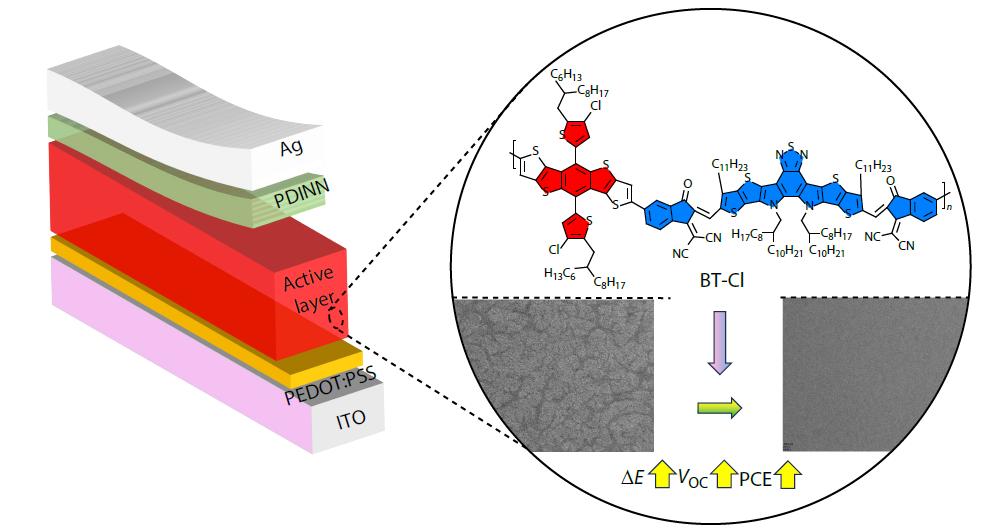
In this study, a polymer acceptor named BT-Cl with a “bridging” structure, which contained a benzodithiophene unit analogous to that of donor D18, and cyano (CN) groups and heterocyclic structures similar to those in acceptor N3, was synthesized. The “bridging” structure ensured good compatibility of BT-Cl with both D18 and N3, and effectively helped to reduce the large phase separation size of D18/N3 binary blend film when added as a third component. Meanwhile, the addition of BT-Cl to the D18/N3 blend can improve the crystallinity and enhance the light absorption efficiency to some extent. The “bridging” structure also resulted higher lowest unoccupied molecular orbital (LUMO) energy level of BT-Cl than that of N3, which effectively improve the open-circuit voltage (VOC) of the ternary device and consequently the power conversion efficiency (PCE). This work showed that the polymer with “bridging” structure as the third component was an effective strategy to decrease the large phase separation size.
Silica aerogels (SAs) impart low density and excellent thermal insulation to polymer systems, yet incorporating hydrophobic SAs into aqueous rubber latex systems remains challenging owing to their poor dispersibility and potential to destabilize the latex. Although previous studies have dispersed SAs in aqueous poly(vinyl alcohol) (PVA), the stability of such dispersions and their effectiveness as bridging media for latex integration have not been thoroughly evaluated, which limits their practical application in latex compounding. This study systematically examined how the surface chemistry governs hydrolytic stability, interfacial behavior, and latex compatibility in PVA-assisted aqueous processing. Two hydrophobic SAs were prepared: ethoxy-modified SA (E-SA) and methyl-modified SA (M-SA). Both initially formed a homogeneous PVA slurry, but E-SA rapidly hydrolyzed its surface ―OCH2CH3 groups, releasing ethanol, becoming hydrophilic, and undergoing irreversible nanopore collapse. In contrast, M-SA maintains its structural integrity and hydrophobicity because its ―Si(CH3)3 groups are highly resistant to hydrolysis. This divergence dictates the behavior during latex blending. The ethanol released from E-SA disrupts electrostatic and steric stabilization, inducing latex coagulation, whereas M-SA/PVA dispersions preserve colloidal stability across diverse latex systems. As a practical demonstration, M-SA-reinforced chlorosulfonated polyethylene (CSM) rubber latex composites show more than a 50% reduction in thermal conductivity while maintaining chemical resistance, enabling high-performance insulating protective gloves and coatings. This work establishes a critical link between aerogel surface chemistry and aqueous processing stability, providing a mechanistic foundation for the rational design of water-based rubber/silica aerogel composites and next-generation thermal insulation materials.
The efficient regulation of sunlight to minimize unnecessary energy exchange through windows plays a vital role in advancing building energy efficiency. However, the inferior stability of cerium-doped tungsten trioxide (CWO) as a near-infrared (NIR) shielding material, combined with the poor mechanical properties of its coatings, poses significant challenges for long-term thermal insulation performance. Here, a hierarchical thermal insulation coating with multifunctional integration has been developed. The inner layer’s excellent NIR shielding performance (94.4%) results in a temperature reduction of 13.6 °C, demonstrating outstanding thermal insulation. Meanwhile, the external layer composed of polysilsesquioxane grafted by carboxylated hexafluoropropylene trimer offers exceptional weather resistance due to the low surface energy. The fluorosilicone coating effectively mitigates oxidation of CWO, as evidenced by the retention of NIR shielding performance even after 30 days of exposure to 60 °C and 90% relative humidity. Furthermore, the coating demonstrates superior anti-graffiti properties and achieves an ultra-high mechanical strength of 0.49 GPa through precise fluorine content modulation. This hierarchical design integrates high hardness, excellent abrasion resistance, anti-graffiti functionality, transparency, and long-term operational durability into a single smart window system, offering a promising solution for reducing building energy consumption.
To combine the high elasticity and good mechanical performance of isoprene rubber (IR) with excellent fatigue resistance and low heat build-up of Eucommia ulmoides gum (EUG), the present study employed a chemical method to graft 4-amino pyridine (AP) onto epoxidized IR and EUG, thereby creating a chemical assembly rubber of amino-pyridine-grafted epoxidized IR (AP-EIR) and amino pyridine-grafted epoxidized EUG (AP-EEUG) via a dynamic hydrogen bonding network. The presence of hydrogen bonds between AP-EIR and AP-EEUG was confirmed by variable temperature infrared spectroscopy, whereas scanning electron microscopy-energy dispersive spectroscopy revealed a uniform dispersion of zinc oxide and nano-fillers. Hydrogen bonds significantly facilitate strain-induced crystallization between the AP-EIR and AP-EEUG molecules, thereby strengthening their intermolecular interactions. During mechanical deformation, the material primarily dissipates energy through the breaking of hydrogen bonds, which effectively improves the mechanical strength of the material, and the introduction of amino groups in this chemical assembly rubber improves the uniform dispersion of nano-fillers, as well as the interface interaction between rubber and nano-fillers. Consequently, the chemically assembled rubber exhibited superior modulus, tensile strength, and tear strength compared to IR and its physical blend, while also demonstrating reduced heat build-up during dynamic loading.
We investigated the phase behavior of diblock copolymer AB/homopolymer C blends in concentrated aqueous solutions using a simulated annealing method. Phase diagrams were constructed as a function of the concentration of all polymers (Φ) and the volume fraction of homopolymer (fC). Rich phase transition sequences were observed, especially reentrant phase transitions, such as lamellae → inverted cylinders → gyroids → lamellae → disorder, for a given Φ with increasing fC. By analyzing the variations in the average contact numbers between different components and the effective volume fractions of B-domains, we elucidated the mechanisms of the reentrant phase transitions. We found that the strong attraction between B and C leads to the swelling of B-domains upon addition of homopolymer. Concurrently, the solvent preferentially swells the A-domains over the B+C-domains. The competing swelling effects of the solvent and homopolymer on the A-domains and B-domains, respectively, triggered the reentrant phase behavior in the symmetric AB copolymer system upon addition of homopolymer.
Poly(aryl ether sulfone) with fatty-acid side chains that crosslink with epoxy resin improves the interfacial compatibility between poly(aryl ether sulfone) and epoxy resin. Hydroxyl-terminated phenolphthalein-based poly(aryl ether sulfone) (PPES-OH) was blended with fatty-acid side-chain-modified phenolphthalein-based poly(aryl ether sulfone) (PPES-TA), with the goal of further enhancing the toughening effect on epoxy resin. In this study, PPES-OH, PPES-TA, and a composite poly(aryl ether sulfone) (PESP-TA) were synthesized. Their molecular structures and thermal properties were characterized using proton nuclear magnetic resonance spectroscopy (1H-NMR spectroscopy), thermogravimetric analysis (TGA), and differential scanning calorimetry (DSC). Subsequently, PPES-OH, PPES-TA, and PESP-TA were introduced into the anhydride-cured epoxy system to evaluate their toughening effects on epoxy resin. The curing behavior of the epoxy resin blends was investigated using DSC, which also enabled the exploration of the corresponding curing mechanisms. The thermal and mechanical properties of the toughened systems were characterized. Scanning electron microscopy (SEM) was used to observe the impact fracture surfaces of the resin, which revealed ‘fish-scale’ structures and shear bands in the resin system after curing. These findings demonstrate that similar thermoplastic chains become entangled with one another, forming additional physical cross-links. This enhanced the interfacial compatibility between the thermoplastic and thermoset resins, which, in turn, significantly improved the impact toughness and elongation at break of the system. In summary, PESP-TA has emerged as a reactive thermoplastic toughening agent that is feasible for preparation and has significant practical application potential.
The currently reported conductive hydrogels are mainly used to detect the mechanical signals of human movement, whereas the application of detecting weak electrophysiological signals in epidermal electrodes is still limited by a low signal-to-noise ratio and motion artifacts. In this study, a one-pot method was used to prepare a hydrogel conductor with excellent flexibility, self-adhesiveness, and compliance by introducing chitosan quaternary ammonium salt (HAAC) and 2-acrylamide-2-methylpropanesulfonic acid (AMPS) into the polyacrylamide (PAAm) hydrogel network. By adjusting the AMPS and HAAC contents, the hydrogel showed skin-like mechanical properties and surface adhesion, successfully eliminating the gap with the skin surface. The self-adhesive hydrogel showed a lower impedance (approximately 190 kΩ) than commercial Ag/AgCl electrodes. Notably, the hydrogel electrodes exhibited a significantly higher signal-to-noise ratio (SNR) than the commercial electrodes at the same level of muscle contraction. The hydrogel electrodes could accurately detect dynamic weak EMG signals and successfully drive the prosthetic hand to grasp without errors. Importantly, the combination of hydrogel strain sensors and epidermal electrodes can quantify the mode, frequency, and intensity of human movement, which has broad application prospects in data acquisition for daily exercise, fitness, and rehabilitation.
Viktor A. Novikov, Elena V. Stegno, Andrey V. Grachev, Ali D. Aliev, Victor Yu. Bychkov, Irina O. Plyusnina, Uliana V. Nikulova, Aleksey V. Shapagin, Alexander Yu. Shaulov, Alexander A. Berlin
A new principle for producing fire-resistant polymer materials with increased deformation properties using a flame retardant not as a heterogeneous additive, but as a thermoplastic flame retardant in a hybrid polymer mixture with a polyhydrocarbon is considered. Hybrid polymer blends of low-molecular ammonium polyphosphate (APP) with an ethylene-vinyl acetate copolymer (EVA) with an APP content of 80 wt% with enhanced deformation properties were obtained by extrusion mixing at various temperatures in the range from 200 °C to 250 °C. A chemical scheme for the transformations of the components during the formation of the composite is proposed. X-ray diffraction analysis showed the formation of new crystalline structures of APP. The phase structure of the systems corresponding to the model of a dispersed-filled composite in which EVA plays the role of a matrix, determining the deformation of the mixture, and the filler is ammonium polyphosphate, was studied by scanning electron microscopy (SEM). The method of FTIR microscopy showed chemical interactions between EVA and APP with the formation of amide groups. The conditions for obtaining compositions characterized by heat resistance of 210 °C, oxygen index of 55 and ultimate elongation at drawing of 213% were established.